%20(Logo)-4.png)


Why Bespoke
Plans Matter
A planting plan from a garden centre or a Pinterest board tells you what looks nice in someone else's garden. A bespoke plan tells you what will thrive in yours.
Every garden has its own microclimate, its own soil character, its own personality. The plants that flourish in a sunny, free-draining border in Sevenoaks are not the same as those that will thrive in a shaded, clay-heavy corner in Tonbridge. Getting this right is the difference between a border that struggles and one that rewards you for years.
Our planting plans are underpinned by genuine RHS-qualified horticultural knowledge and a chemical-free, wildlife-friendly approach to plant selection. We choose plants that support pollinators, build healthy soil, and contribute to the ecological richness of your garden — while looking beautiful doing it
Some Gardens Feel Almost Right
Some gardens feel almost right. The bones are good, the structure is there — but something is missing. Perhaps the borders feel a little flat, or a corner has lost its purpose, or you simply want more colour, more movement, more life woven through what you already love.
That's where a bespoke planting plan from Consciously Grown comes in.
We don't arrive with a formula. We arrive with curiosity — about your soil, your aspect, your light, your seasons, and the plants that already call your garden home. From that understanding we create a planting plan that feels completely right for your specific space, building on what's working and gently evolving what isn't.
The result is a beautifully presented, printed plan you can refer to again and again — with clear plant recommendations, how they work together, and why each choice has been made.
Case Studies
A garden in Kings Hill — "a little planting help"
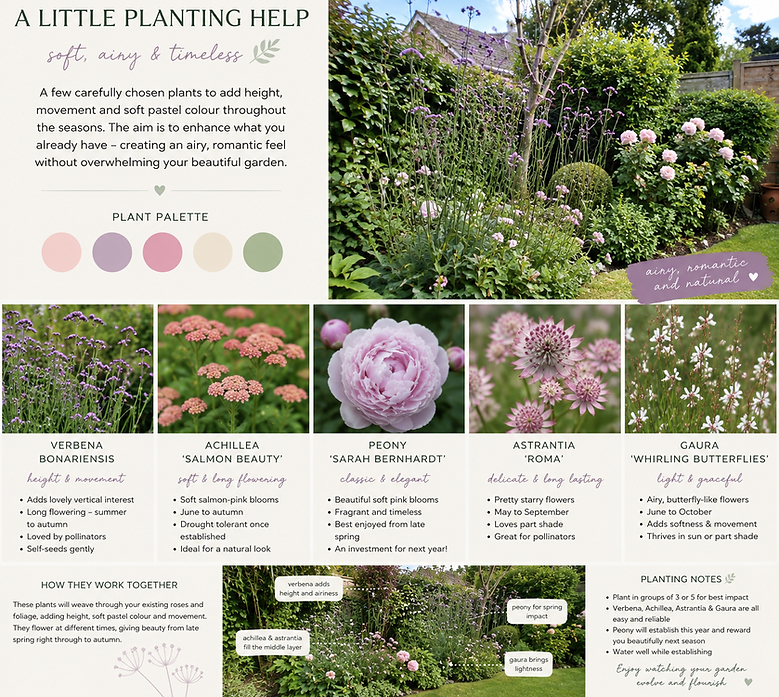
Jill has a characterful, established garden in Kings Hill with good bones — beautiful climbing roses, a mature camellia, generous alchemilla mollis in the borders and a lovely mix of mature shrubs and trees giving year-round structure.
Her brief was simple: she wanted to add soft pastel colour to elevate what was already there, without overwhelming the natural, romantic feel of the space.
We visited, spent time understanding the existing planting, light conditions and seasonal gaps, and created a bespoke plan around a carefully chosen palette of just six plants.
"Enjoy watching your garden evolve and flourish."

A Garden In Offham - Brief "Bring the garden together beautifully"
Verbena bonariensis for height and movement, Achillea 'Salmon Beauty' for long-flowering softness, Peony 'Sarah Bernhardt' for timeless elegance, Astrantia 'Roma' for delicate, long-lasting colour, Gaura 'Whirling Butterflies' for lightness and grace, and Camellia japonica 'Nuccio's Pearl' for year-round structure and winter flowering.
Each plant was chosen to weave through the existing roses and foliage, flowering at different times to give beauty from late spring right through to autumn and into winter.
The plan included notes on how they work together, where to position them for best effect, and practical advice on establishment.
The Garden Before


Phillip, Sevenoaks— solving a shady problem
Brief: a small budget to enhance difficult shady areas where mature trees were blocking light and roots were making planting challenging
Phillip's garden presented a genuinely tricky horticultural challenge. Mature trees had created dense shade and extensive root competition across a central border — conditions that defeat most plants and leave many gardeners feeling like there's nothing to be done. The challenge was to find plants that would not only survive those conditions but thrive in them, filling the space with year-round colour, texture and structure.
Working with a modest budget, we created a rich, layered planting plan built around plants that genuinely love shade and root competition and then went on to develop another border with completely different conditions and aspect within the garden.
Hydrangea paniculata 'Little Lime' for reliable summer to autumn flowering, Photinia 'Red Robin' for evergreen structure with dramatic new growth, Pieris japonica 'Forest Flame' for colourful spring interest, Astilbe 'Visions in Red' which actively thrives in clay soil, Crocosmia 'Lucifer' for fiery late-summer colour beloved by bees, Carex oshimensis 'Evergold' for soft arching texture all year round, Heuchera 'Palace Purple' for bold evergreen foliage contrast, and Astrantia 'Roma' for light, airy flowers that pollinators love.
The result is a warm, rich border with year-round interest — deep burgundy, fiery orange and lime green creating a layered, natural feel that complements the existing garden beautifully. Every plant was chosen to be low maintenance, dog friendly and tough enough to handle the conditions without chemical support.
"A fresh new swath that brings depth, colour and movement to the garden."


FAQ
What is a bespoke garden planting plan?
A bespoke garden planting plan is a tailored document that specifies exactly which plants should be placed where in your garden, based on your specific soil type, aspect, light conditions, existing planting and aesthetic preferences. Unlike generic planting guides, a bespoke plan is created after a visit to your garden and a conversation about what you want to achieve. At Consciously Grown, every planting plan is designed around what you already have — working with your garden's character rather than imposing a design on it.
Can a planting plan work for an established garden?
Yes — and in fact most of our planting plans are created for established gardens rather than new ones. An established garden already has structure, maturity and often sentimental planting that deserves to be respected and built upon rather than replaced. A good planting plan for an established garden identifies what's working well, introduces new plants to fill seasonal gaps, and creates a more cohesive, layered picture over time. Established gardens often see the most rewarding results because the framework is already there — it simply needs thoughtful, considered refinement.
Do I need to redesign my whole garden to get a planting plan?
Not at all. In fact we rarely recommend wholesale changes to established gardens. A bespoke planting plan can be as focused or as wide-ranging as you need — from a single border that needs refreshing to a comprehensive plan for the whole garden. Many of our clients simply want to add colour, movement or seasonal interest to what they already have, and a targeted planting plan is the perfect way to achieve that without disruption.
What does an organic planting plan look like?
An organic planting plan prioritises plants that support soil health, attract beneficial insects and pollinators, and reduce or eliminate the need for chemical intervention. This means selecting naturally disease-resistant varieties, companion plants that deter pests without spraying, and species that improve soil structure through deep roots or ground-covering habits. Our planting plans always specify peat-free, sustainably sourced plants and include guidance on organic soil preparation, mulching and feeding to support long-term garden health without chemicals.
How do you choose the right plants for my garden?
Plant selection begins with understanding your garden's conditions — soil type, pH, drainage, aspect and shade levels. We then consider the existing planting, the seasonal gaps you want to fill, the aesthetic you're drawn to, and the wildlife value of each plant. We look for plants that will genuinely thrive in your specific conditions rather than plants that look good in a nursery but struggle in your garden. Every plant in a Consciously Grown planting plan has been chosen for a reason — and we explain those reasons clearly in the plan itself.
How do plants work together in a planting plan?
Great planting is about relationships between plants — how they layer in height, how they sequence through the seasons, how their colours and textures complement or contrast with each other, and how they support the broader ecology of the garden. A well-designed planting plan creates a succession of interest from early spring through to late autumn and winter, with different plants taking centre stage at different times. We design for this flow deliberately, so your garden always has something beautiful happening.
What is companion planting and why does it matter?
Companion planting is the practice of growing plants together that benefit each other — either by deterring pests, attracting beneficial insects, improving soil fertility or simply growing more successfully in each other's company. In a kitchen garden, for example, growing basil near tomatoes deters aphids, while planting marigolds through vegetable beds attracts hoverflies whose larvae feed on pests. In an ornamental garden, flowering perennials planted near fruit trees attract the pollinators that improve yields. We incorporate companion planting principles throughout our plans as a natural, chemical-free approach to garden health.
How do I plan a garden for year-round interest?
Year-round interest is achieved through deliberate layering of plants with different seasons of peak performance. A well-planned garden has structural evergreens providing form and colour in winter, early bulbs and blossom in spring, a peak of perennial flowering in summer, seed heads and late flowers in autumn, and winter-flowering shrubs and berries to close the year. At Consciously Grown we design every planting plan with this seasonal arc in mind — so there is always something beautiful to look at and something for wildlife to feed on, whatever the time of year.
How do I incorporate a kitchen garden into an existing garden?
A kitchen garden can be integrated into an existing garden in many ways — from a dedicated raised bed area to a more ornamental potager style where vegetables, herbs and flowers are grown together decoratively. The key considerations are light (most vegetables need at least six hours of sun), access for harvesting and maintenance, soil improvement, and how the kitchen garden relates visually to the rest of the space. We design kitchen garden areas that are both productive and beautiful — working with the character of the wider garden rather than imposing a utilitarian allotment aesthetic.
What is a regenerative approach to garden planting?
A regenerative approach to garden planting prioritises building soil health, supporting biodiversity and working with natural systems rather than against them. This means avoiding chemical fertilisers and pesticides, using mulch and organic matter to feed the soil, choosing plants that support native wildlife, and allowing a degree of natural self-seeding and ecological complexity rather than imposing rigid control. Over time a regeneratively managed garden becomes more resilient, more self-sustaining and more beautiful — because healthy soil and diverse planting create the conditions for plants to truly thrive.
Can I have a planting plan as a standalone service without ongoing maintenance?
Yes absolutely. A bespoke planting plan is available as a standalone service — you receive the site visit, the consultation and the printed plan, and then you're free to implement it yourself, at your own pace, with whoever you choose. Many of our planting plan clients do go on to become long-term maintenance clients because they enjoy watching the plan come to life with our team — but there is no obligation whatsoever.
How long does it take to create a planting plan?
Following the initial site visit and consultation, we typically produce your planting plan within two to three weeks. More complex gardens or larger-scale plans may take a little longer. We'll always give you a clear timescale when we meet.
Ready to see what your garden could become?
Request a Bespoke Planting Plan Consultation
Every garden has a next chapter. Whether you want to add soft colour to an established border, create a productive kitchen garden, or evolve the whole space gradually and thoughtfully — we'd love to help you find it.
Arrange a consultation and we'll come to you, spend time with your garden, and begin the conversation.